



What is Nine Men's Morris?
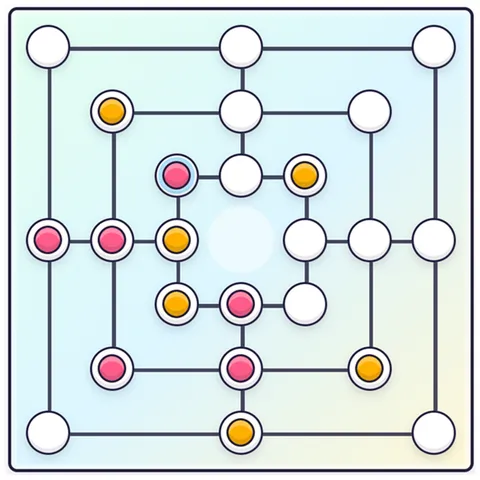
Nine Men's Morris is a classic two-player strategy board game played with nine pieces per player. The aim is to make mills, remove opposing pieces and leave your opponent with fewer than three pieces or no legal move.
A mill is a straight line of three of your pieces along one of the board's marked lines. Each time you form a new mill, you remove one opposing piece that is not protected inside another mill, unless every opposing piece is in a mill.
- Each player starts with nine pieces off the board.
- Players take turns placing pieces on empty points.
- Three pieces in a line make a mill.
- Making a mill lets you remove one opposing piece.
- After all pieces are placed, pieces slide along the board lines.
- When a player has only three pieces, those pieces may fly to any empty point.
How to play Nine Men's Morris online
Choose Vs AI to play the computer, or choose 2 players for a same-screen match. During the placing phase, click any empty point. During the moving phase, click one of your pieces and then a highlighted destination.
If a move creates a mill, the board enters capture mode. Pick an opponent piece to remove, then the turn passes. The status message above the board always tells you whether to place, move or remove a piece.
- Use Easy AI while learning the rules.
- Use Medium AI for a steadier tactical opponent.
- Use Hard AI when you want the computer to look ahead.
- Watch for highlighted points after selecting a piece.
- Start a new game any time without leaving the page.
Nine Men's Morris strategy for beginners
Good Nine Men's Morris strategy starts before the moving phase. Try to place pieces where they threaten more than one future mill, because double threats force the opponent to defend.
Do not chase every capture if it leaves your pieces trapped. A strong position keeps pieces connected, keeps several lines alive and makes it hard for the opponent to close your movement.
- Claim intersections that belong to several possible mills.
- Block an opponent's open two-in-a-row before it becomes a mill.
- Build flexible pairs instead of one obvious line.
- Avoid isolating pieces with only one escape route.
- In the flying phase, count immediate mill threats before moving.
AI difficulty levels
Easy AI chooses legal moves with a light preference for making mills and captures, which makes it useful for learning the rhythm of the game. Medium AI scores mills, blocks, mobility and material before choosing.
Hard AI searches ahead through likely replies, values double threats and tries to reduce your mobility. It is still a friendly browser opponent, but it gives a much sharper Nine Men's Morris challenge.
Why Nine Men's Morris is a logic and strategy game
Nine Men's Morris has perfect information: there are no cards, dice or hidden pieces. Every threat comes from visible lines, legal movement and the timing of captures.
That makes it a natural fit for players who enjoy logic puzzle games, abstract strategy games and classic board games that reward planning rather than speed.
The three phases of Nine Men's Morris
A full game of Nine Men's Morris moves through up to three phases, and knowing which one you are in shapes every decision. In the placing phase, the players take turns putting their nine pieces on empty points. In the moving phase, once all pieces are on the board, you slide a piece along a line to an adjacent empty point. The optional flying phase begins for a player the moment they are down to three pieces: from then on, that player may jump a piece to any empty point.
Each phase rewards different thinking. Placing is about claiming strong points and setting up several mills at once; moving is about opening and closing mills without freeing the opponent; flying is a last stand where a trailing player can suddenly create threats anywhere. Many beginners forget the flying rule and resign too early — three pieces that can fly are still dangerous.
- Placing phase: take turns placing all nine pieces on empty points.
- Moving phase: slide a piece to an adjacent empty point along a line.
- Flying phase: with only three pieces left, a player may jump anywhere.
- Forming a mill in any phase lets you remove an opposing piece.
- You lose if you drop below three pieces or have no legal move.
Mills and the swinging double mill
A mill is three of your pieces in a row along a marked line, and forming one lets you capture an enemy piece. The deepest tactic in Nine Men's Morris is the running mill, often called a double mill or swinging mill: an arrangement where a single piece moves back and forth between two mills, completing a fresh mill — and capturing a piece — on almost every turn.
Setting up a swing usually wins, so both building one and preventing one decide most games. The strongest points to fight for are the four T-junctions where lines cross, because they belong to the most potential mills; corners, with only two connections, are the weakest. When you remove an opponent's piece, prefer one that breaks an emerging double threat over one tucked safely away.
- A mill is three in a row along a board line.
- Forming a mill removes one opposing piece (not one already in a mill, unless all are).
- A swinging double mill re-forms a mill every move, capturing repeatedly.
- Fight for the four cross points that join the most lines.
- Break an open two-in-a-row before it closes into a mill.
A short history of Nine Men's Morris
Nine Men's Morris is one of the oldest board games still played today. Boards have been found cut into ancient Roman tiles and medieval cathedral steps, and the game was hugely popular across Europe in the Middle Ages. It goes by many names, including Mills, Merels and Merrills.
Shakespeare even mentions it in A Midsummer Night's Dream — “the nine men's morris is fill'd up with mud” — a nod to the large outdoor versions once cut into village greens. The version here keeps the traditional 24-point board and the placing, moving and flying rules, with adjustable computer difficulty for a quick modern game.