
What is Jigsaw Sudoku?
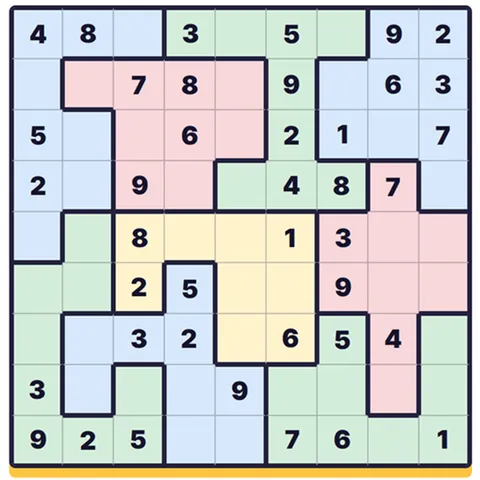
Jigsaw Sudoku is a 9x9 number-placement puzzle. As in classic Sudoku, every row and every column must contain the digits 1 to 9 exactly once. The twist is in the third constraint: instead of nine square 3x3 boxes, the grid is divided into nine irregular regions of nine cells each, drawn in soft colours so you can see where one piece ends and the next begins.
You will see this puzzle sold under several names. Newspapers print it as Irregular Sudoku, Squiggly Sudoku, Geometry Sudoku, Nonomino Sudoku or Chaos Sudoku, but the rules are identical every time. Each region snakes across the board, sometimes spanning three rows and three columns, sometimes stretching into a long ribbon.
- Every row contains the digits 1 to 9 once.
- Every column contains the digits 1 to 9 once.
- Every coloured jigsaw region contains the digits 1 to 9 once.
- Regions are irregular nine-cell shapes, not 3x3 boxes.
- A well-made puzzle has exactly one solution and never needs guessing.
How to play Jigsaw Sudoku online
Start where the grid is most crowded. A row, column or region that already holds many digits forces the missing ones quickly. Because regions wander across the board, a single region can touch several rows and columns at once, so placing one digit often clears candidates in surprising places.
Use notes whenever a cell has more than one possible digit. Pencilling in candidates is the safest way to handle the irregular shapes, since the region you are scanning may bend away from the obvious 3x3 grouping your eye expects.
- Tap or click an empty cell to select it.
- Press a number button or a keyboard key 1-9 to place a digit.
- Turn on Notes to write small candidate digits instead of an answer.
- Use Hint to reveal one correct cell when you are stuck.
- Use Undo or Erase to take back a move, and New game for a fresh layout.
Jigsaw Sudoku vs classic Sudoku
The solving logic is the same family: naked singles, hidden singles, pairs and pointing candidates all still work. What changes is your geometry. In classic Sudoku your eye learns to chunk the grid into nine neat squares. In Jigsaw Sudoku those chunks are gone, so you must read each region by its colour rather than its position.
That shift makes interactions between rows, columns and regions far richer. A region that dips into three different rows links those rows together in ways a 3x3 box never could. Many players find Jigsaw Sudoku a refreshing retraining of habits they built over years of standard puzzles.
The law of leftovers
Jigsaw Sudoku has one signature technique that classic Sudoku rarely rewards: the law of leftovers. Pick a band of rows, say the top three rows. Those three rows must contain three full sets of the digits 1 to 9. Now compare them with the regions that lie mostly inside that band.
If a region pokes out of the band, the cells sticking out must contain exactly the same digits as the cells from outside regions that poke in. Those two small groups of leftover cells are forced to hold an identical multiset of digits. On hard and expert grids this single idea can crack a position that looks completely stuck.
Difficulty levels and why play online
Easy puzzles give you more starting digits and plenty of direct placements, which is the friendliest way to learn how irregular regions behave. Medium is a balanced daily challenge, Hard asks for steady candidate work, and Expert leans on the law of leftovers and longer chains of deduction.
Playing online keeps everything tidy. The board highlights the row, column and region linked to your selected cell, the timer tracks your solve, completed digits dim on the number pad, and your progress saves locally in your browser so you can step away and come back to the same grid.
- Easy: more givens and direct placements for new solvers.
- Medium: a balanced everyday irregular Sudoku.
- Hard: fewer clues and more candidate tracking.
- Expert: region geometry and the law of leftovers take over.