What is LITS?
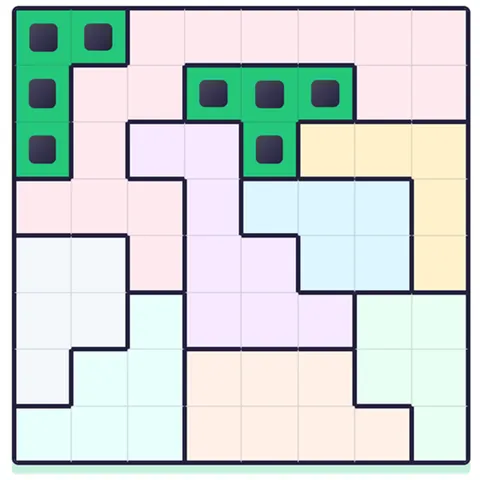
LITS is a shading logic puzzle played on a grid divided into irregular regions. Your job is to shade one tetromino in every region, using only the L, I, T and S tetromino shapes.
The O tetromino is not used because it would create a forbidden 2x2 shaded block. A good LITS puzzle has one logical solution, so the challenge is deduction rather than guessing.
- Shade exactly four connected cells in every region.
- The four shaded cells in a region must form an L, I, T or S tetromino.
- All shaded cells must join into one connected area.
- No 2x2 block may be fully shaded.
- Matching tetromino types may not touch horizontally or vertically, even when rotated or reflected.
How to play LITS online
Choose a grid size and difficulty, then shade cells until each coloured region contains one legal tetromino. The board checks the full LITS rule set, including region shapes, 2x2 blocks, connectivity and matching shapes touching.
Small 6x6 LITS puzzles are best for learning the rules. The 8x8 and 10x10 boards give more room for connected-shading logic and harder shape choices.
- Tap a cell to shade it.
- Tap it again to clear it.
- Use Check to highlight current rule problems.
- Use Undo to step back one move.
- Use Solution only when you want to reveal the unique answer.
LITS solving strategies
Start inside the regions. If a region has only a few possible tetromino placements, compare them with neighbouring regions and remove any placement that creates a 2x2 shaded square.
Next, think globally. The shaded cells must form one connected group, so isolated tetrominoes are suspicious unless another region can connect to them later. Matching shapes touching edge-to-edge are also a strong source of eliminations.
- List the possible L, I, T and S placements in tight regions.
- Eliminate any placement that completes a 2x2 shaded square.
- Watch for same-shape neighbours across region borders.
- Keep the shaded cells connected as the solve develops.
- Use forced regions to limit the shape choices nearby.
Grid sizes and difficulty
This LITS game includes 6x6, 8x8 and 10x10 boards. Easy puzzles keep the candidate shapes tighter, medium puzzles add more cross-region choices, and hard puzzles make you track connection and shape-touching rules for longer.
Every built-in puzzle has been checked by a solver for a single solution. That uniqueness check is expected for LITS because multiple solutions would make the puzzle feel ambiguous.
- Easy: smaller boards and more direct region deductions.
- Medium: more candidate shapes and connected-area reasoning.
- Hard: larger regions, fewer immediate placements and deeper eliminations.
Why play LITS here?
This free LITS online page is built for quick play: no signup, bright region colours, multiple grid sizes, undo, checking and a readable strategy guide underneath the game.
If you searched for play LITS online, free LITS puzzle, LITS game, LITS rules or LITS strategy, this page gives you the playable puzzle and the rule explanation in one place.
What the name LITS means
The name LITS is simply the four tetromino shapes you are allowed to use. I is four cells in a straight line. L is three in a line with one cell turned at the end. T is three in a line with one cell on the middle. S is a two-step zig-zag, and its mirror image, the Z, counts as the same S shape. Every region must be filled with exactly one of these four, never anything else.
Two tetrominoes are deliberately left out. The O — a 2x2 square — is banned because shaded cells may never form a 2x2 block anywhere on the board. Rotations and reflections of L, I, T and S still count as that same letter, which matters for the rule that two matching shapes may not touch edge-to-edge.
- I: four cells in a straight line.
- L: three in a line with one cell bent at the end (J is the same type).
- T: three in a line with one cell on the centre.
- S: a two-step zig-zag (Z counts as the same shape).
- O, the 2x2 square, is never allowed.
A worked LITS deduction
The easiest cells to place sit in small regions. A region of exactly four cells must be shaded completely, so its shape is fixed — and if those four cells would form a square, the region could not be solved, so a valid four-cell region is always an L, I, T or S. Lock those in first; they give you fixed shaded cells to build outward from.
Then let the global rules cascade. Because every shaded cell must join one connected group, a freshly placed tetromino tells its neighbours where they must connect, often forcing a single placement in the next region. At the same time, check the borders: if a placement would sit edge-to-edge with a same-shaped tetromino, or close a 2x2 block with cells across the border, it is wrong and the alternative is forced.
- A four-cell region is shaded entirely, so its tetromino is fixed.
- Use those fixed cells as anchors for the connected group.
- A placed tetromino often forces how the next region must connect.
- Reject placements that touch a same-shaped tetromino edge-to-edge.
- Reject placements that complete a 2x2 block across a border.
LITS, Nuruomino and Nikoli
LITS is a Nikoli puzzle, from the Japanese publisher famous for Sudoku, Nurikabe and Shikaku. Its name is an acronym of the four allowed tetrominoes — L, I, T and S — and it was originally published under the name Nuruomino, which blends the Japanese word for shading with 'omino' from polyomino.
Like its Nikoli siblings, a proper LITS puzzle is designed for one logical solution with no guessing. The version here keeps the full rule set — one tetromino per region, all shaded cells connected, no 2x2 blocks and no matching shapes touching — and offers 6x6, 8x8 and 10x10 boards so you can learn on a small grid and work up.